
Mechanicsville Previous Residents by Era
The source to use depends on the time period and the question. Deeds establish transfers of an interest in land, not a complete list of occupants. Directories, newspapers, church material, and census records can offer household clues, but each has gaps and needs to be matched to a date and place. Hanover’s records loss makes this mix especially important. Begin with the source that is closest in time to the address event, then compare identifiers rather than treating a single name hit as a final answer.
| Source | Years it covers | Where held | What it shows |
|---|---|---|---|
| Deed books, name index | 1959 forward in name search | Hanover Circuit Court Clerk Self-Service | Recorded parties, transfers, book/page or instrument links |
| Historic deed and plat indexes | 1865–1967 | Clerk Historic Index Search and Historic Books | Grantor/grantee, deed, and plat leads |
| Surviving county material | 1865 forward in varying runs | County genealogy route and LVA | Land, court, will, marriage and related records |
| Regional directories | 1801–1929 broad collection | William & Mary finding aid and repositories | Dated name, address, business or occupation lead |
| Ashland Herald-Progress | 1919–2018 | Virginia Chronicle via HCHS finding aid | Road, church, event, obituary, and business clues |
Exact Mechanicsville directory title and year runs were not verified from the public regional collection. Confirm a title and its access terms with Pamunkey Regional Library, the Hanover County Historical Society, LVA, or another repository before treating it as address coverage.
Mechanicsville Past Residents Parcel Pivot
Start the backward trail with the Hanover County Real Estate Assessments page and its parcel application. Search by property address, mailing address, subdivision, parcel ID or GPIN. Record the GPIN, current situs address, owner display if public, subdivision or lot, tax year, and any sale or deed reference. The GPIN is the best link between a modern address and a deed search because street numbers and postal labels can change over time.
Do not equate the tax mailing address with a person’s residence. Assessment information is not a deed, title opinion, boundary survey, or list of everyone who lived at the property. It is the launch point for a specific chain of title and for locating a plat or tax-map sheet.
Mechanicsville Previous Residents Deed Chain
The Hanover Circuit Court Clerk Self-Service page makes free indexes available, while document images have separate access. Current deed books are listed as name-searchable from 1959 forward, and the separate Historic Index Search and Historic Books cover 1865–1967 grantor, grantee, deed and plat material. Use the current parcel’s party name and legal description first. Then move backward one transfer at a time.
- Copy the GPIN, exact owner or party name, legal description, and recorded deed date from the parcel record.
- Find that acquisition in the Clerk index and record the instrument or book/page, grantor, grantee, record date, and cited plat.
- Search the seller from that transfer as a grantee to identify the seller’s own acquisition.
- Repeat the direction of travel, preserving spouse, trustee, estate, middle-initial, and corporate variants only when the instrument supports them.
- When the online path reaches an older gap, use the Historic Index Search, Historic Books, LVA microfilm, or the Clerk’s records room rather than guessing a link.
- Grantor
- The party who conveys or transfers an interest in a recorded instrument.
- Grantee
- The party who receives the interest in that instrument.
- Chain of title
- The sequence of recorded transfers that connects one owner or interest to an earlier one.
- Legal description
- The lot, metes-and-bounds, or plat-based land description that may outlast a street-number change.
Mechanicsville Past Residents Index Access
The Clerk’s Self-Service page distinguishes free indexes, historic search links, login controls, and Secure Remote Access. The Clerk lists immediate image access through Secure Remote Access at $50 monthly or $500 annually, subject to current terms. The subscription removes a separate image-copy charge, but it is not the only path to a record.
This county capture shows the Self-Service choices for a Mechanicsville previous residents search.
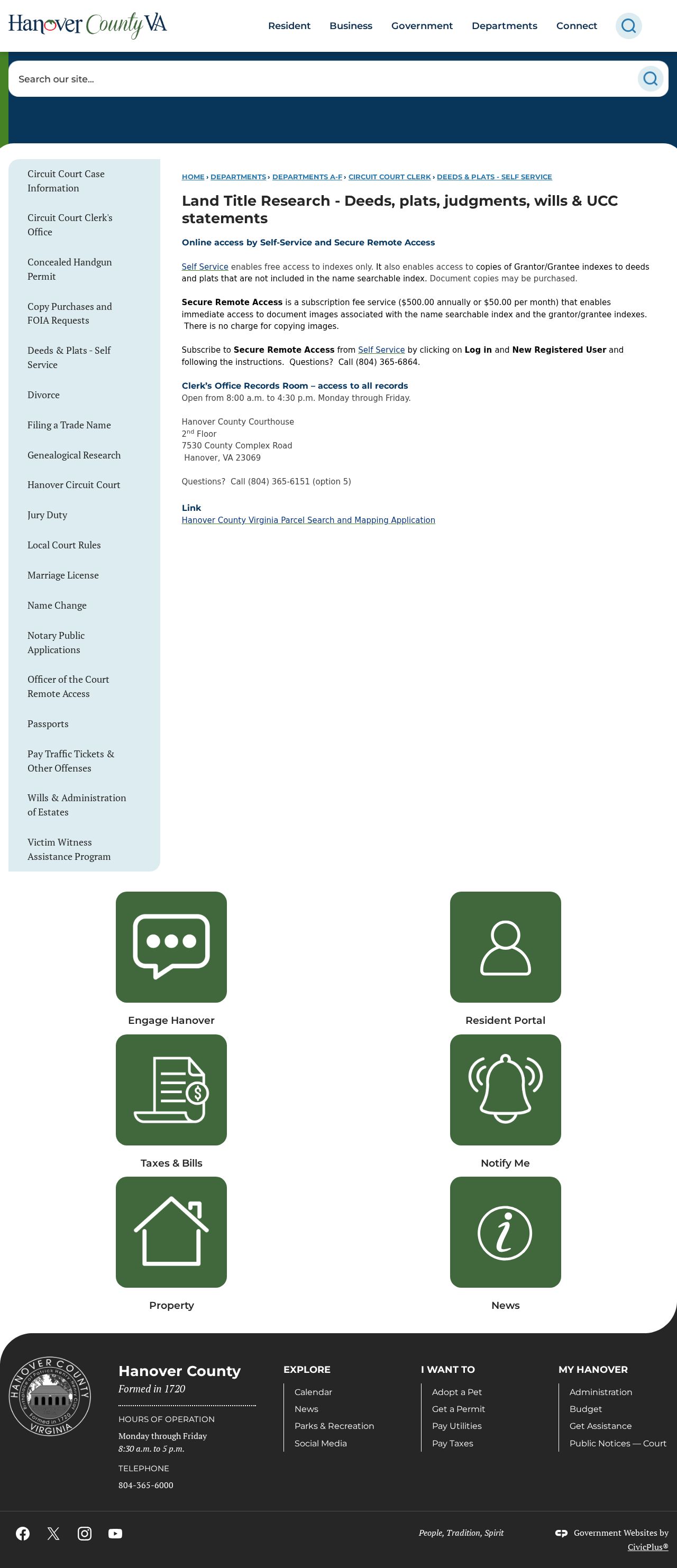
For an in-person alternative, use the Clerk records room at 7530 County Complex Road, second floor, during the listed weekday hours. The county also lists mail copies through Hanover Circuit Court Clerk, P.O. Box 39, Attention Copies, Hanover VA 23069, and land-record help at 804-365-6864.
Mechanicsville Previous Residents Record Loss
Hanover’s historic trail has a known break. During the Civil War, county records were moved toward Richmond for safekeeping. The Richmond fire of April 3, 1865 destroyed many county deed, court, will, marriage, suit-paper, and license records; other Clerk materials were lost when the office was ransacked. A surviving postwar record is not proof that every earlier record survived, and a missing pre-1865 record does not prove that no transfer or household existed.
The useful response is a repair matrix: start with surviving post-1865 deeds and marriage indexes, then compare land books, court and chancery material, church sources, military material, newspapers, census records, and LVA microfilm. Identify a source as direct evidence or a lead. Keep “not found,” “not indexed,” and “destroyed or unknown” as different outcomes.
Research tip. Record a book/page or instrument number before opening another source. That small identifier keeps a prior-owner trail auditable when names repeat.
Mechanicsville Past Residents at LVA
The Library of Virginia Hanover collection lists uneven but valuable runs of county material. It includes court-order, common-law, and chancery series from 1809 onward in varying spans, deed books from 1865 onward, annual land books, fiduciary accounts, an Orphans’ Book, and voter-registration book runs. LVA describes microfilm availability and interlibrary-loan options; its reading room is at 800 East Broad Street in Richmond.
This LVA capture identifies the Hanover collection and its lost-record context.

Use the collection inventory to select a title and date range before requesting microfilm or a lookup. The collection is not a single address index.
Mechanicsville Past Residents Household Trail
A deed chain answers who transferred land. It may not answer who lived there before. For household research, use directories, census schedules, newspapers, parish material, land books, and obituaries as dated leads. A regional city or business directory can connect a person to a street, business, occupation or household at a moment in time, but rural and unincorporated addresses may be omitted or filed under Hanover, Ashland, Richmond, a post-office label, or a nearby route.
- Write down the deed date, road name, legal description, subdivision or lot, and original spelling.
- Check a directory or newspaper title for that period under Mechanicsville, Hanover, Ashland, Richmond, road and post-office variants.
- Pair the dated clue with the closest census-era source, keeping the enumeration district distinct from a current ZIP or street label.
- Use church, marriage, land-book, probate, or obituary material to test a relationship or move date.
- Return to the deed chain when a person or road lead suggests an earlier transfer.
The Mechanicsville city directories collection route is the place to verify a directory title, year, and access method. It should not be assumed that a broad Virginia catalog is complete coverage for this community.
Mechanicsville Previous Residents Genealogy Sources
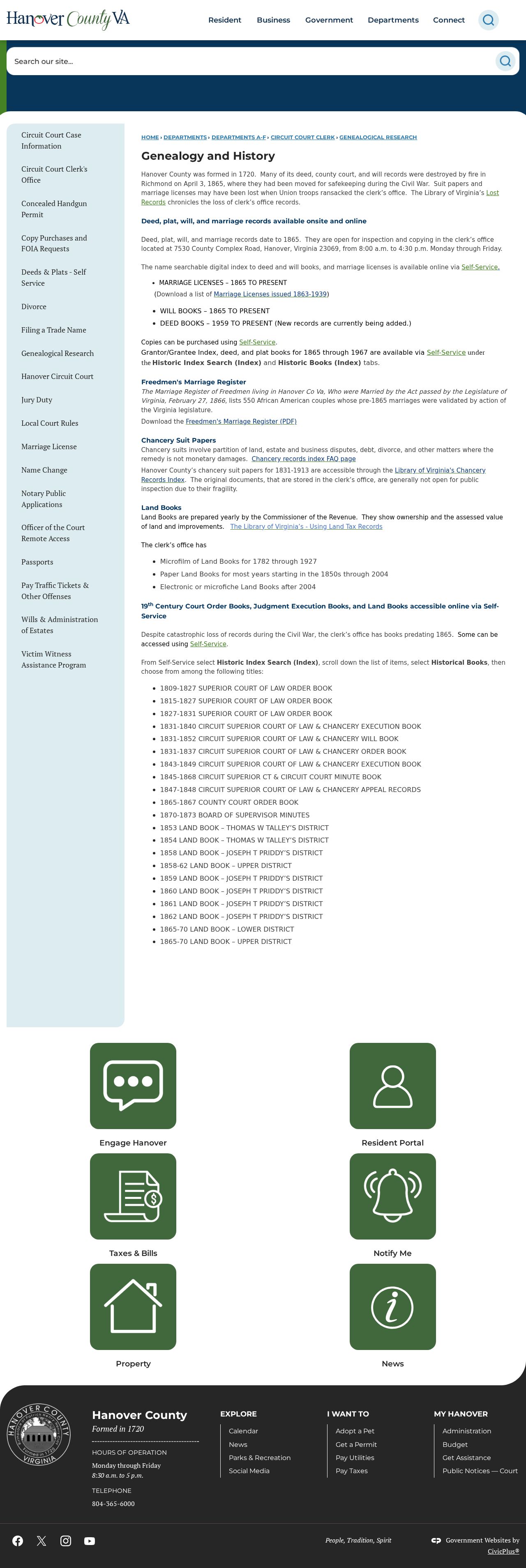
Hanover County Genealogical Research points to surviving historic material and expressly warns about destroyed records. It identifies marriage licenses from 1865 forward, wills from 1865 forward, historic index material, selected land books, and a chancery index. Its research sequence moves from a person, family, road, or court clue into deeds, land books, court material, parish and church sources, newspapers, census, and directories.
This county genealogy capture is a practical reminder that past residents research needs several source types.
For a pre-modern-address trail, HCHS lists St. Paul’s Parish Vestry Book for 1787–1802 and local diary or medical-journal materials. Preserve the historic spelling of names and places when comparing them with later deeds.
Mechanicsville Previous Residents Address Crosswalk
Do not assume that a modern ZIP or street number maps directly onto a nineteenth-century location. Build an address crosswalk from the USPS delivery result, county GIS, GPIN, tax-map sheet, current road, parcel neighbors and recorded plat. Then search the deed’s legal description, historic road or turnpike terms, newspaper advertisements, church names and directory labels. Preserve the modern and original forms side by side.
The DHR architectural history calls Mechanicsville an 1816 turnpike-era settlement and identifies roads such as Mechanicsville Turnpike, Atlee, Luck, Pickett, Signal Hill, older Strain or Edgeworth, and Elm as historical context. No official Mechanicsville-specific street-renumbering chronology was located, so any attempted address conversion needs a source note.
Mechanicsville Previous Residents Use Limits
Previous residents research is strongest when used for a house history, family connection, estate matter, or local-history question. It is not a way to assemble a profile of living people. A public record may be incomplete, redacted, restricted, dated, or tied to an owner rather than an occupant. Virginia’s Address Confidentiality Program can lawfully replace a physical address with a substitute address. Do not try to locate a protected address through other records.
Lawful personal use. Use Mechanicsville address history carefully and respect protected information. Never use historical or current address records to stalk, harass, track, or harm another person.
When a historical item is missing, ask the proper custodian for the specific existing record or consult the library and archive access routes. A broad request for everyone who lived at an address is not a substitute for a source-by-source trail.